
How Federal Safety Rule Violations Turn Florida Truck Crashes Into Stronger Legal Claims
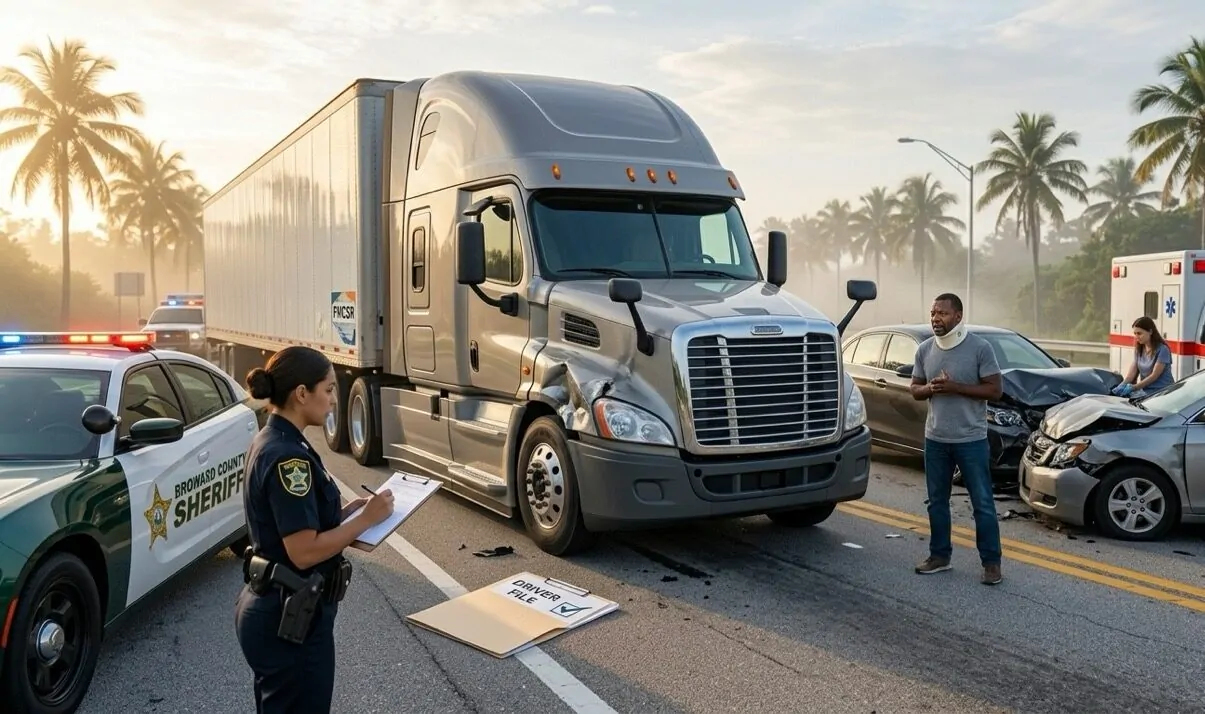
A semi-truck travels southbound on I-95 through Broward County after exceeding its legal driving hours. The driver begins drifting between lanes. Traffic slows ahead near an interchange. The truck fails to brake in time. A multi-vehicle collision follows, involving several passenger vehicles.
This is not just driver error. This is how FMCSR violations in Florida truck accidents often occur.
Federal Motor Carrier Safety Regulations exist to prevent exactly these crashes. When trucking companies or drivers ignore these rules, catastrophic injuries become far more likely.
If you have been hurt in a crash involving FMCSR violations, a truck accident lawyer from C.H. Smith Law Firm can evaluate your case and help you pursue the compensation you deserve.
What FMCSR Violations Mean in Florida Truck Accident Cases
FMCSR stands for Federal Motor Carrier Safety Regulations. These are federal rules that govern how commercial trucks must operate on American roads. These rules limit how long drivers can stay on the road before taking rest breaks. They also ensure trucks receive proper maintenance to stay mechanically safe. In addition, they require cargo to be secured correctly to prevent shifting during transport.
They establish driver qualification standards, including licensing and training requirements. They also mandate regular inspections and accurate recordkeeping. When any of these rules are broken, the crash that follows is often foreseeable and preventable. In Florida truck accidents, FMCSR violations become critical evidence. They help establish that the trucking company or driver failed to meet a federal legal standard. That failure often forms the foundation of a negligence claim.
The Most Common FMCSR Violations Found After Truck Accidents
Most truck crashes do not happen without warning signs. In the majority of FMCSR violations in Florida truck accidents, investigators uncover regulatory failures that existed long before the crash occurred. These are not freak accidents. They are the predictable result of rules being ignored.
Here is a closer look at the violations that appear most often in post-crash investigations:
Hours-of-Service Violations
Federal law limits how many consecutive hours a commercial truck driver can operate before taking a mandatory rest break. These limits exist because fatigued driving is one of the leading causes of serious truck crashes. When a driver exceeds those hours, reaction time slows and judgment deteriorates.
Trucking companies sometimes pressure drivers to push past legal limits to meet delivery deadlines. Logs may be falsified to conceal the violation. In Florida truck accidents involving fatigue, hours-of-service records are among the first pieces of evidence a commercial truck accident attorney will demand.
Poor Vehicle Maintenance
Commercial trucks must meet strict federal maintenance standards. Brake systems, tires, steering components, and lighting must all be inspected and serviced on schedule. When maintenance is skipped to reduce costs or save time, equipment failures follow. Brake fade on a fully loaded semi-truck traveling at highway speed is catastrophic.
Tire blowouts at high speeds cause drivers to lose control instantly. These failures are not random. They are the direct result of ignoring federal inspection requirements. A trucking accident lawyer in Florida will subpoena maintenance records to establish exactly when the failure began and who knew about it.
Improper Cargo Securement
Federal regulations require cargo to be loaded, distributed, and secured according to specific standards. A load that shifts during transit can throw a truck off balance, cause rollovers, or send debris onto the roadway. These crashes frequently injure multiple people across several lanes.
Construction materials, industrial equipment, and palletized goods are common culprits in securement failures. In FMCSR violations in Florida truck accidents involving shifting cargo, liability may extend to the warehouse operator or freight broker responsible for the original loading.
Driver Qualification Failures
Not every driver behind the wheel of a commercial truck is legally qualified to be there. Federal regulations require valid commercial driver’s licenses, medical clearance, and documented training before a driver can legally operate certain vehicles.
When trucking companies skip background checks, hire drivers with disqualifying records, or fail to verify credentials, they create serious crash risk. These qualification failures are often uncovered through driver personnel files, which a semi truck accident lawyer in Florida can obtain through the discovery process.
Inspection and Recordkeeping Violations
Federal law requires trucking companies to maintain detailed records of inspections, repairs, driver logs, and safety certifications. These records exist to create accountability. When records are missing, incomplete, or falsified, it often signals a company culture that treats compliance as optional.
Courts and juries view falsified logs seriously. In FMCSR violations in Florida truck accidents, recordkeeping failures frequently indicate that the crash was not an isolated incident but part of a broader pattern of neglect.
How Federal Violations Give Your Truck Accident Claim Real Legal Power
Proving that a truck driver made a mistake is one thing. Proving that a trucking company violated a federal safety regulation is another level entirely. FMCSR violations do not just support your case. They can fundamentally change its outcome.
When a trucking company breaks a federal rule and a crash results directly from that violation, courts may apply negligence per se. This legal doctrine means the violation itself serves as proof of negligence. You do not need to separately argue that the conduct was unreasonable. The federal government already decided it was. That shifts the burden significantly in your favor.
FMCSR violations in Florida truck accidents also increase pressure on trucking companies during settlement negotiations. Documented regulatory failures expose companies to higher liability and potential punitive damages. Insurers are far less willing to lowball a claim when federal violations are already on the record. In many Florida truck accidents, identifying and proving FMCSR violations is the single most important factor in determining final compensation.
Where FMCSR-Related Truck Accidents Occur in South Florida
FMCSR violations in Florida truck accidents occur throughout South Florida, concentrated in areas with the heaviest commercial freight activity. Broward County sees many serious trucking crashes in areas like Fort Lauderdale, Plantation, Hollywood, Pompano Beach, and Oakland Park. These cities sit close to major distribution hubs and port routes, which increases heavy truck traffic.
Across Miami-Dade County, Hialeah, Miami Gardens, and Doral handle constant commercial truck movement through industrial zones and logistics centers. In Palm Beach County, freight traffic moves heavily through Boca Raton and West Palm Beach, especially along I-95 and nearby connecting roads.
The highest-risk roadways include the I-95 corridor running through all three counties, the Florida Turnpike serving long-haul and regional freight, I-595 connecting Port Everglades to inland distribution points, and US-441 carrying consistent commercial traffic through densely populated areas. Heavy freight volume across all of these routes increases the likelihood of FMCSR violations in Florida truck accidents daily.
How Investigators Prove FMCSR Violations After a Crash
Proving a federal regulatory violation requires more than a police report. The most powerful evidence in FMCSR violations in Florida truck accidents is almost always in the possession of the trucking company. Moving quickly to secure that evidence before it is altered or destroyed is one of the most important things an attorney can do.
A commercial truck accident attorney will pursue the following evidence immediately after being retained:
- Electronic Logging Device (ELD) Data: Reveals the driver’s actual hours of operation and identifies potential fatigue violations that official logs may conceal.
- Maintenance and Inspection Records: Shows whether the truck met federal safety standards prior to the crash and whether known defects were repaired or ignored.
- Driver Qualification Files: Includes licensing history, medical certifications, training records, and employment background to identify any disqualifying factors.
- Black Box Data: Records speed, braking force, steering input, and engine performance in the seconds before impact, providing an objective account of driver behavior.
- Company Safety Policies: Internal documents and communications may reveal that management was aware of violations or actively discouraged compliance to cut costs.
How Florida Law Applies to FMCSR Violations
Federal violations do not exist in a vacuum. They interact directly with Florida state law in ways that shape how your claim is built, argued, and ultimately valued. Understanding this intersection is essential to building a strong case.
When federal safety rules are broken and a crash results, the legal consequences extend well beyond the federal regulatory system. Florida courts take FMCSR violations seriously as evidence of negligent conduct, and a skilled Florida truck accident lawyer uses that evidence strategically across every aspect of your claim.
Comparative Negligence
Florida follows a modified comparative negligence rule. Insurance companies routinely attempt to shift a portion of fault onto the injured driver to reduce their payout. When FMCSR violations are clearly documented, that strategy becomes much harder to execute. Federal violations place the responsibility squarely on the commercial operator and make fault-shifting arguments far less credible in front of a judge or jury.
Serious Injury Threshold
Florida law requires victims to meet a serious injury threshold before they can pursue full damages beyond PIP coverage. This includes permanent impairment, significant scarring, or disfigurement. In cases involving FMCSR violations in Florida truck accidents, the severity of injuries often meets this threshold. Your attorney will work with medical experts to document the full extent of your injuries and ensure they are properly characterized under Florida law.
Corporate Liability
Trucking companies are responsible for the conduct of their drivers and the condition of their equipment. When FMCSR violations reflect systemic failures in safety culture, training, or maintenance, the company itself becomes a primary defendant. A trucking accident lawyer in Florida builds the case against the corporation, not just the individual driver, which is where the real accountability and insurance coverage exist.
How FMCSR Violations Affect Settlement Value
The presence of documented FMCSR violations directly increases what a truck accident claim is worth. Insurance carriers know this. When federal violations are clearly established, the case for a higher settlement becomes significantly stronger. Clear regulatory violations remove ambiguity about fault. There is no reasonable argument that following federal law was optional.
Catastrophic injuries tied to a documented violation show that the harm was foreseeable and preventable. Documented corporate negligence, particularly patterns of repeated violations, may support punitive damages in addition to compensatory recovery.
In serious Florida truck accidents, FMCSR violations can be the difference between a modest settlement and full compensation that accounts for long-term medical care, lost earning capacity, and the real cost of what you have been through.
Why Some Truck Accident Claims Fail Without FMCSR Evidence
Not every truck accident claim succeeds. Many victims accept far less than their case is worth because the right evidence was never gathered. Without documented FMCSR violations, the legal picture changes significantly. Insurance companies dispute liability when there is no regulatory paper trail to hold the trucking company accountable.
Claims become dependent on witness accounts, which adjusters challenge as subjective and inconsistent. Settlement leverage drops because the insurer knows the case is harder to prove. Defense attorneys use the absence of violation evidence to argue the crash was simply an unavoidable accident.
FMCSR evidence transforms a he-said-she-said dispute into a documented failure by a company that knew the rules and broke them anyway. In FMCSR violations in Florida truck accidents, that evidence often determines whether a victim receives fair compensation or walks away with far less than they deserve.
Attorney Courtney Smith’s Approach to FMCSR Truck Accident Cases
Attorney Courtney Smith is a Florida Bar credentialed personal injury attorney with nearly 20 years of legal experience. His practice at C.H. Smith Law Firm includes serious commercial truck accident litigation across South Florida. He has handled trucking accident cases involving federal regulatory violations, corporate negligence, and complex multi-party liability.
Attorney Smith is familiar with Broward County Circuit Court procedures and understands how local judges evaluate trucking cases. He works with accident reconstruction experts and industry specialists to analyze FMCSR violations in Florida truck accidents and translate technical regulatory failures into compelling legal arguments. His understanding of how trucking companies operate from the inside allows him to anticipate defense strategies and build cases that hold carriers fully accountable.
What Clients Say About C.H. Smith Law Firm
Google reviews consistently praise our communication, professionalism, and results in injury cases. Client testimonials highlight our thorough preparation and aggressive representation in court proceedings.
“You have definitely chosen the perfect attorney if you are reading this review! They work efficient, and effective! Great communication, professional and friendly. I had great results and will always use attorney C.H Smith, if I ever need attorney services in the future. Thank you for a wonderful experience  .”
.”
— Charlotte Hilliard
Frequently Asked Questions About FMCSR Violations
1. What does FMCSR stand for and why does it matter in my truck accident case?
FMCSR stands for Federal Motor Carrier Safety Regulations. These federal rules govern commercial truck operations, and violations of them often serve as direct evidence of negligence in your claim.
2. Can I use FMCSR violations to prove the trucking company was at fault?
Yes. When a trucking company violates a federal safety regulation and a crash results, courts may apply negligence per se, treating the violation itself as proof of fault.
3. How do I find out if the truck driver violated hours-of-service rules before my crash?
Your attorney can subpoena Electronic Logging Device data and driver logs, which record actual driving hours and can reveal whether the driver exceeded federal limits.
4. Does a FMCSR violation automatically increase my settlement amount?
Not automatically, but documented violations significantly strengthen your negotiating position and give your attorney stronger grounds to pursue higher compensation.
5. Can I sue the trucking company directly for FMCSR violations in Florida?
Yes. If a trucking company’s failure to comply with federal regulations contributed to your crash, you can pursue a claim directly against the company in addition to the driver.
6. How quickly should I contact a Florida truck accident lawyer after a FMCSR-related crash?
You should contact an attorney as soon as possible. Black box data, ELD records, and maintenance logs can be overwritten or destroyed quickly without a legal hold in place.
7. What happens if the trucking company destroyed records after my crash?
Destruction of evidence after a crash can constitute spoliation. Courts may impose sanctions or allow juries to draw negative inferences against the company that destroyed the records.
8. Do FMCSR rules apply to all commercial trucks in Florida?
Federal FMCSR regulations apply to commercial vehicles engaged in interstate commerce. Many trucks operating in South Florida fall under these rules due to crossing state lines or operating from federally regulated carriers.
9. Can cargo securement violations cause a truck accident claim to include multiple defendants?
Yes. If improper loading contributed to the crash, liability may extend to the warehouse operator, freight broker, or loading contractor in addition to the trucking company.
10. How does a commercial truck accident attorney investigate FMCSR violations after a crash?
Your attorney issues immediate legal holds, subpoenas driver files and maintenance records, retains accident reconstruction experts, and analyzes ELD and black box data to build a documented case.
Speak With C.H. Smith Law Firm About FMCSR Truck Accident Cases
FMCSR violations in Florida truck accidents involve federal regulations, corporate liability, and multiple insurance carriers. These cases require fast action and experienced legal representation. C.H. Smith Law Firm helps injured clients identify violations, preserve critical evidence, and pursue the compensation they deserve. Contact us today for a free consultation.
Plantation Office
7805 S.W. 6th Court, Plantation, FL 33324
Phone: +1 (954) 228-9334
Tampa Office
201 E. Kennedy Blvd, Suite 600, Tampa, FL 33602
Phone: +1 (813) 322-5335
Email: info@chsmithlaw.com
