
Can You Sue a Scooter Company for Mechanical Failure? A Florida Law Perspective
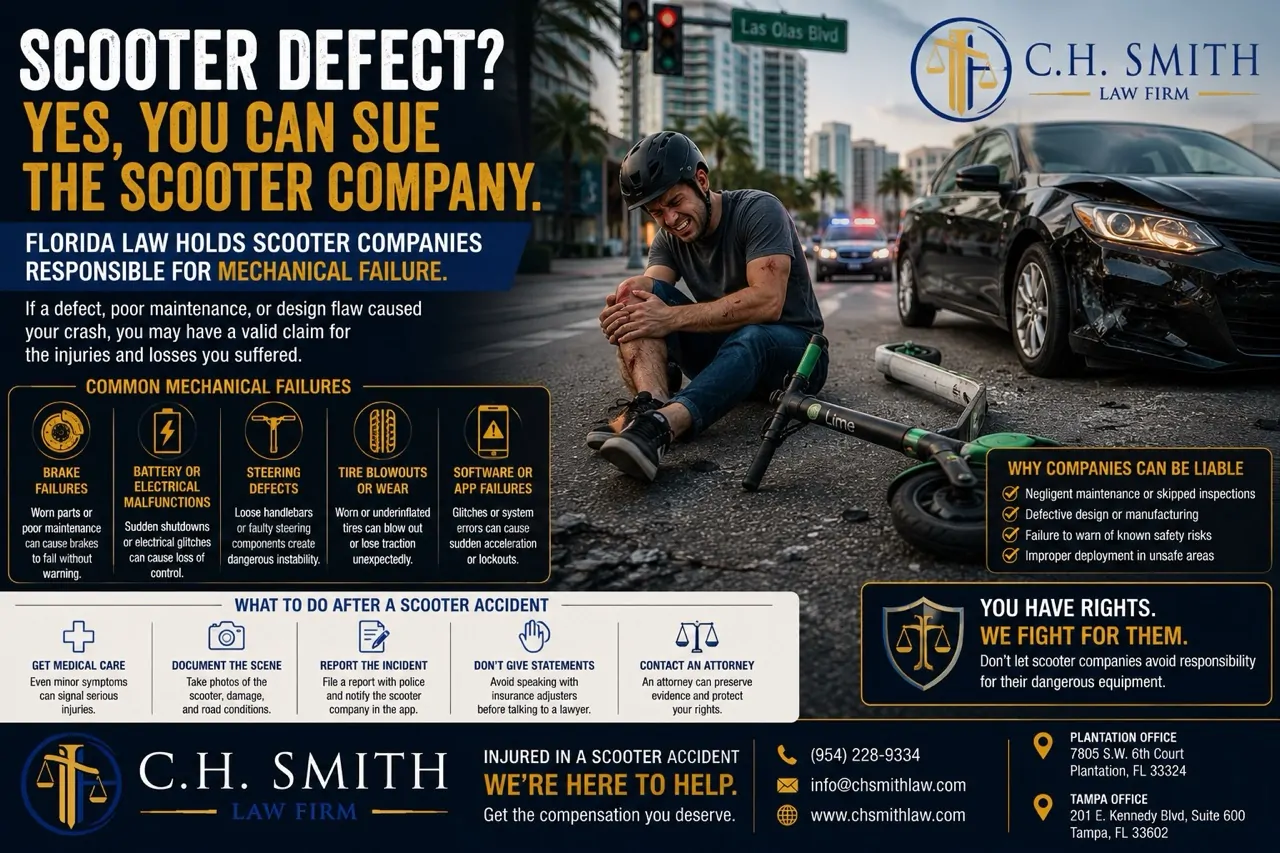
A rider travels through Fort Lauderdale near Las Olas Boulevard on a shared electric scooter. Without warning, the brakes fail approaching a busy intersection. The rider cannot stop in time. A collision follows and causes serious injuries. This is not always rider error.
In many cases, mechanical failure raises serious legal questions about whether the scooter company bears responsibility for what happened. Florida law allows injured riders to pursue claims when defective equipment or poor maintenance contributed to their accident. If you’ve been hurt due to a hardware malfunction, an attorney for rental scooter injury claims can help you navigate the complex liability shift between the software provider and the maintenance contractor. At C.H. Smith Law Firm, we specialize in identifying these technical failures to ensure that the companies putting these vehicles on our streets are held accountable for their safety.
Florida Law and Scooter Company Liability
Yes, you may be able to file a claim against a scooter company in Florida when a mechanical defect, maintenance failure, or design issue caused your injuries. This type of claim does not depend solely on whether another driver was at fault. It focuses on whether the scooter itself was unsafe and whether the company that deployed it failed in its duty to provide a properly functioning device.
A scooter company lawsuit in Florida typically falls under product liability and negligence law, both of which give injured riders meaningful legal grounds to pursue compensation from the company responsible for maintaining the device.
What Counts as a Scooter Mechanical Failure Under Florida Law
Not every scooter crash involves driver error or road hazards. Some crashes happen because the device itself failed. Florida law recognizes several categories of mechanical failure that can form the basis of a defective scooter injury claim.
Here is how different types of mechanical failure are evaluated in these cases:
Brake Failures
Brakes are the most critical safety system on any vehicle. When a scooter’s brakes fail to engage properly or stop responding during a ride, the rider loses their primary ability to avoid a collision. Brake failures caused by worn components, inadequate inspection, or design defects are among the most common mechanical issues that support a scooter company lawsuit in Florida.
Battery or Electrical Malfunctions
Shared electric scooters depend on battery systems that power both the motor and the safety features. Sudden shutdowns mid-ride, unexpected acceleration caused by electrical glitches, or throttle malfunctions can all cause a rider to lose control without any warning. When electrical system failures trace back to defective components or inadequate maintenance schedules, the company faces direct liability.
Steering or Handlebar Defects
Loose handlebars, worn steering joints, and faulty connection points between the handlebar and the scooter frame create instability that makes the device dangerous even at low speeds. When a steering defect causes a crash, the maintenance records that show whether the issue was known and left unaddressed become central to the electric scooter accident Florida claim.
Tire Blowouts or Wear Issues
Scooter tires are small and low-profile, which means wear and pressure problems affect handling dramatically. Companies that fail to inspect tire condition before redeployment expose riders to blowout risk on roads where even a brief loss of traction can result in serious injury. Deploying a scooter with visibly worn or underinflated tires supports a negligent maintenance claim directly.
Software or App Malfunctions
Modern shared scooters are operated and unlocked through software platforms. When the app fails to properly communicate with the scooter’s mechanical systems, issues like unintended acceleration, failure to engage locks, or incorrect speed limiting can arise. Software defects are increasingly recognized as a basis for a sue scooter company for defect claim under Florida product liability law.
When a Scooter Company Can Be Held Legally Responsible
Scooter companies do not escape liability simply because a rider accepted terms of service. When a company’s own failures created the dangerous condition that caused your crash, Florida law holds them accountable. A scooter accident lawyer in Florida examines the company’s conduct across several potential liability categories.
Here is when legal responsibility attaches to the scooter company directly:
Negligent Maintenance
Scooter companies have an ongoing duty to inspect, service, and repair their devices before deploying them for public use. When a company skips maintenance cycles to keep more scooters in service, or fails to address known mechanical issues flagged by previous riders, it has breached its duty of care. That breach creates direct liability when the unaddressed failure causes an injury.
Defective Design or Manufacturing
Some scooter failures trace back not to poor maintenance but to the original design or manufacturing of the device. When a component fails because it was improperly engineered or built with substandard materials, the company that designed or produced it faces product liability exposure regardless of whether maintenance was properly performed. A Florida product liability lawyer pursues these claims against both the manufacturer and the deploying company.
Failure to Warn Riders
When a company becomes aware of a known defect or safety risk associated with its scooters, it has a legal obligation to warn users before they ride. Failing to communicate known risks through app notifications, physical labels, or removal from service creates independent liability when a rider is injured by the undisclosed hazard.
Improper Deployment in Unsafe Areas
Placing scooters in areas where road conditions, traffic volume, or infrastructure make their safe use unreasonably dangerous may support a negligence claim against the company. When a scooter company deploys devices in high-risk intersections or zones without adequate safety consideration, that deployment decision becomes part of the liability analysis.
How Florida Product Liability Law Applies to Scooter Accidents
Florida product liability law provides injured riders with multiple legal theories for pursuing a scooter company lawsuit. Understanding which theory applies to your situation shapes how your attorney builds your case.
Florida law recognizes three primary bases for product liability scooter accident claims:
Strict Liability
Under strict liability, a scooter company may be held responsible for injuries caused by a defective product even without proving that the company was careless. If the scooter was defective and that defect caused your injury, the company bears liability regardless of whether it knew about the problem. This is one of the most powerful tools in a defective scooter injury claim.
Negligence Claims
A negligence claim requires showing that the company failed to exercise reasonable care in maintaining, inspecting, or deploying its scooters. When maintenance logs reveal skipped inspections, or internal records show prior complaints about the same defect, negligence becomes straightforward to establish. These records are obtained through the legal discovery process.
Breach of Warranty
Scooter companies make implicit promises that their devices are safe for their intended use. When a scooter fails to perform safely due to a defect that existed when it was deployed, the company may have breached an implied warranty of merchantability. This legal theory provides an additional avenue of recovery in product liability scooter accident cases.
Where Scooter Accidents Frequently Occur in South Florida
Scooter and micro-mobility accidents involving mechanical failure are concentrated in areas with the highest shared scooter deployment and traffic volume. In Broward County, Fort Lauderdale sees the highest volume of electric scooter accident in Florida cases, particularly near Las Olas Boulevard, downtown corridors, and Beachfront areas where ridership is heaviest.
Hollywood, Pompano Beach, and Oakland Park also see significant scooter activity along their commercial and coastal routes. In Miami-Dade County, the Brickell and Wynwood neighborhoods have high scooter density tied to urban mobility demand. Miami’s downtown intersections and waterfront areas generate frequent crash incidents.
Common risk areas across both counties include downtown intersections where signal timing and turning vehicles create hazards, tourist zones where unfamiliar riders encounter heavy traffic, and high-traffic roads like A1A and US-1 where speed differentials between scooters and vehicles are most dangerous.
What Evidence Helps Prove a Scooter Defect Claim
Building a successful defective scooter injury claim requires evidence that connects the specific mechanical failure to the company’s conduct before your crash. Much of this evidence is in the company’s possession and must be secured through legal action.
Here is the evidence that matters most in these cases:
Scooter Inspection Records
Maintenance logs reveal when the scooter was last serviced, what components were checked, and whether any defects were identified and addressed before the device was redeployed. Gaps in maintenance records or entries showing known issues left unresolved directly support your negligence claim.
Incident Reports from Scooter Companies
Scooter companies maintain internal records of accidents and mechanical complaints reported by previous riders. When prior riders reported the same defect that caused your crash, those records establish that the company had knowledge of the problem and chose not to act on it.
App Usage Data
The scooter’s operational data captured through the platform’s software documents the ride timeline, speed, and any system errors that occurred during your session. This data can confirm when the malfunction occurred and whether the device was operating normally leading up to the crash.
Medical Records
Documentation of your injuries from immediate medical treatment establishes the physical consequences of the crash and links them directly to the mechanical failure. Early medical records are among the most important pieces of evidence in any scooter company lawsuit Florida case.
Strong defective scooter claims rely on a complete evidence package:
- Photos of the defective scooter taken immediately after the crash
- Witness statements from bystanders who observed the malfunction
- Surveillance footage from nearby businesses or traffic cameras
- Repair history records obtained through legal discovery
- Expert mechanical analysis confirming the nature and cause of the failure
Can You Still File a Claim If You Signed a Scooter Waiver?
Many riders assume that signing a terms of service or liability waiver before using a shared scooter eliminates their right to sue. This assumption is often incorrect. Waivers do not provide scooter companies with unlimited protection from legal claims.
Florida courts have consistently ruled that waivers do not always protect companies from liability. A company can still be held responsible if defective equipment caused the injury. Liability may also apply when the company knowingly used an unsafe device. Courts may find fault if the company showed gross negligence.
A company can also be liable if it failed to follow basic maintenance and safety standards, even if a waiver exists. If your crash involved any of these circumstances, a scooter company lawsuit Florida remains a viable legal option regardless of what the waiver stated.
What Compensation May Be Available After a Scooter Defect Accident
Scooter defect accidents can cause serious, life-altering injuries. When a company’s negligence or a product defect caused your crash, Florida law allows you to pursue compensation that reflects the full impact of what you have been through.
Depending on your circumstances, you may be eligible to recover:
- Medical expenses — Emergency treatment, hospitalization, surgeries, and all related care costs tied to your crash injuries.
- Lost income — Wages you were unable to earn during your recovery period due to the severity of your injuries.
- Future treatment costs — Ongoing medical care, physical therapy, and long-term treatment needs identified by your medical team.
- Pain and suffering — Compensation for the physical pain and emotional distress caused by the accident and your recovery.
- Long-term disability damages — When injuries result in permanent impairment, additional compensation reflects the lasting impact on your quality of life and earning capacity.
Compensation in every defective scooter injury claim depends on the strength of liability evidence and the documented severity of your injuries.
How C.H. Smith Law Firm Handles Scooter Defect Cases
Attorney Courtney Smith is a Florida Bar licensed personal injury attorney with nearly twenty years of experience representing injured clients across South Florida. He handles injury and product liability cases in Broward County Circuit Court and understands how local judges evaluate defective product and negligent maintenance claims. He carefully investigates mechanical failures and works with experts to identify the exact cause of the defect and link it to the company’s actions. His review includes maintenance records, internal reports, and app data to build a strong scooter company lawsuit Florida case for you.
Frequently Asked Questions About Scooter Company Lawsuits
1. How do I prove that a scooter defect caused my accident in Florida?
Your attorney secures maintenance records, inspection logs, and expert mechanical analysis to establish that the defect existed before your ride and directly caused your crash.
2. Can I file a claim against both the scooter company and another driver?
Yes. When both a mechanical defect and another driver’s negligence contributed to your crash, you can pursue claims against multiple parties simultaneously.
3. What is the deadline to file a scooter defect lawsuit in Florida?
Florida generally allows two years from the date of the accident to file a personal injury or product liability claim, making early legal action essential.
4. Does it matter if I was riding a shared scooter versus a personal one?
Yes. Shared scooter cases involve the deploying company’s maintenance obligations, while personal scooter cases may focus more on the manufacturer’s design and warranty responsibilities.
5. Can I sue Lime or Bird directly for a scooter malfunction in Florida?
Yes. If a Lime or Bird scooter’s mechanical failure caused your injuries, you can pursue a scooter company lawsuit Florida against the company based on negligent maintenance or product defect.
6. What if the scooter company says the crash was my fault?
Florida’s comparative negligence law allows you to recover compensation even if you share partial fault, though your recovery is reduced by your percentage of responsibility.
7. How does gross negligence affect my scooter defect claim?
Gross negligence, such as knowingly deploying a scooter with a dangerous defect, may allow you to pursue punitive damages in addition to standard compensation.
8. Can I still sue if the scooter was inspected before my ride?
Yes. If the inspection was inadequate or the defect was present but missed due to poor protocols, the company may still be liable for the resulting injuries.
9. Do I need an expert to prove a scooter mechanical failure?
In most cases, yes. A qualified mechanical engineer or product safety expert analyzes the device and provides testimony that establishes the nature and cause of the defect.
10. How long does a scooter defect lawsuit take to resolve in Florida?
Case timelines vary depending on injury severity, available evidence, and whether the case settles or proceeds to trial, but early legal involvement speeds the process significantly.
Speak With C.H. Smith Law Firm About Scooter Defect Accidents
Scooter accidents involving mechanical failure raise complex legal questions about product liability and corporate responsibility. These cases require fast evidence preservation and experienced legal strategy from the beginning. C.H. Smith Law Firm helps injured riders evaluate their claims, gather the evidence needed to prove defect liability, and understand their full legal options under Florida law.
Plantation Office
7805 S.W. 6th Court, Plantation, FL 33324
Phone: +1 (954) 228-9334
Tampa Office
201 E. Kennedy Blvd, Suite 600, Tampa, FL 33602
Phone: +1 (813) 322-5335
Email: info@chsmithlaw.com
