
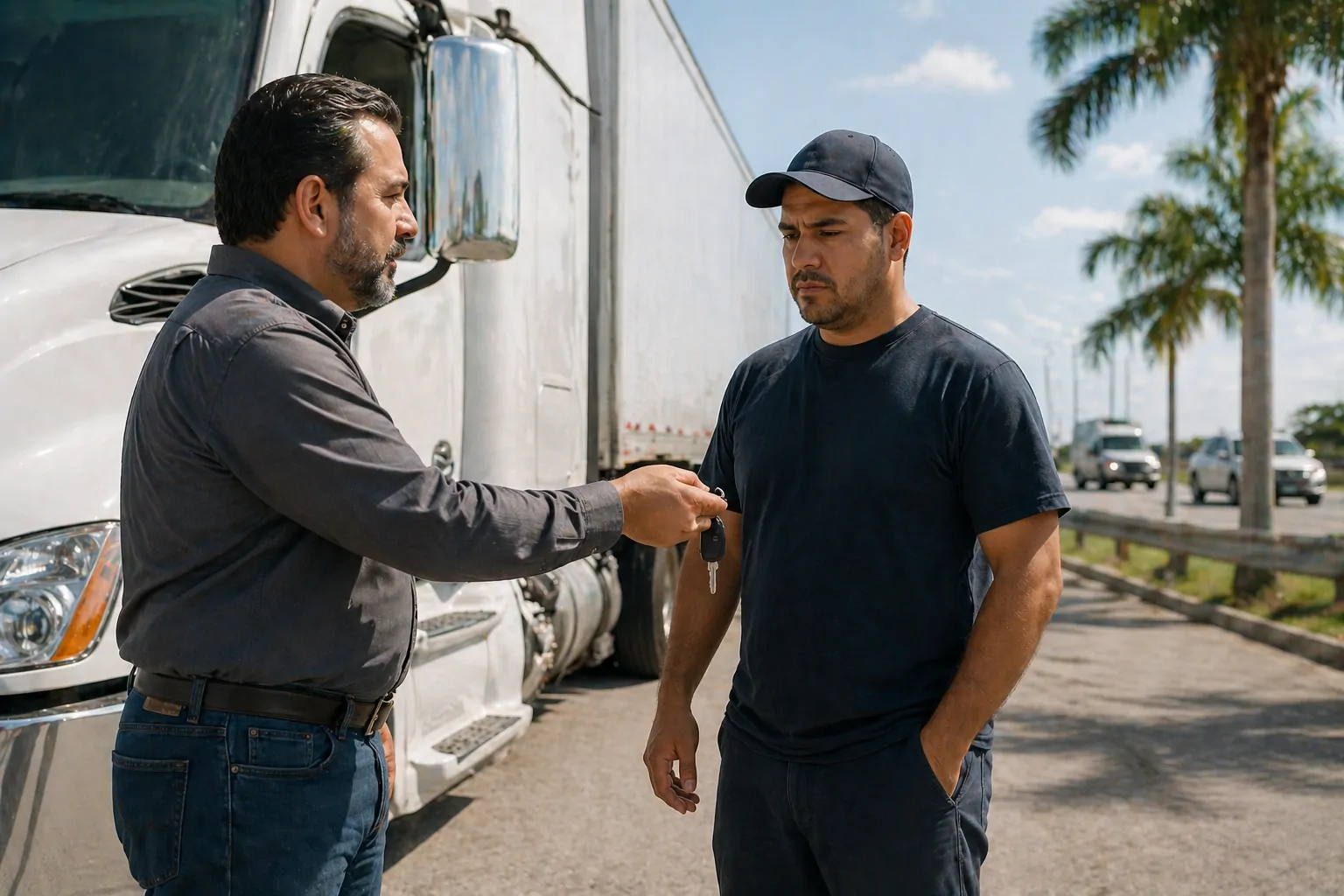
What Is Negligent Entrustment in Florida Truck Accident Claims?
A commercial truck merges onto I-95 in Broward County during morning traffic. The driver has a history of serious traffic violations. His license was suspended twice in three years. The trucking company hired him anyway and handed him the keys to an 80,000-pound vehicle.
Miles later, he causes a devastating crash. The question that follows is not just what the driver did wrong. The more important question is who allowed him on the road in the first place.
This is where negligent entrustment Florida becomes central to your claim. When a company places an unsafe driver behind the wheel of a commercial truck, the company shares direct responsibility for every crash that follows. Understanding this legal concept can fundamentally change who is held accountable and how much compensation is available to you.
What Does Negligent Entrustment Mean in Florida Law?
Negligent entrustment in Florida occurs when a person or company gives control of a vehicle to someone they knew, or should have known, was unfit to operate it safely. The law recognizes that handing keys to a dangerous driver creates foreseeable risk for everyone on the road. It holds the entrusting party accountable for that decision.
Common examples include allowing an unlicensed driver to operate a commercial vehicle, ignoring a driver’s documented history of traffic violations, or placing a driver with known substance abuse issues behind the wheel. In trucking cases, this doctrine extends the legal responsibility beyond the driver to the company that made the hiring and assignment decisions.
How Negligent Entrustment Applies in Truck Accident Cases
Commercial trucking companies have a legal duty to hire, train, and supervise drivers who are qualified and safe. This duty exists because commercial vehicles carry enormous crash potential. An 18-wheeler traveling at highway speed can cause catastrophic injuries when operated by someone unfit for the job.
Employers must vet drivers carefully before placing them on the road. This means reviewing driving records, verifying licenses, confirming medical certifications, and monitoring performance over time. When a company skips these steps or ignores red flags, it crosses from ordinary hiring into negligent entrustment.
The distinction matters legally because driver negligence alone limits liability to the individual. Company negligence through entrustment opens the door to corporate liability and significantly larger insurance coverage.
Key Elements You Must Prove in a Negligent Entrustment Claim
Proving negligent entrustment Florida requires establishing a clear chain of facts that connects the company’s decision to your injuries. Each element must be supported by documented evidence.
To build a successful claim, your attorney must establish the following:
- The driver was unfit or unsafe — This includes a history of traffic violations, license suspensions, substance abuse, medical disqualifications, or lack of proper commercial driver training.
- The company knew or should have known — The trucking company either had direct knowledge of the driver’s unfitness or would have discovered it through a reasonable background check and proper vetting process.
- The vehicle was entrusted anyway — Despite that knowledge or the failure to conduct proper due diligence, the company assigned the driver to operate a commercial vehicle.
- The negligence caused the accident — The driver’s specific unfitness, the very reason they should not have been hired, directly contributed to the crash that caused your injuries.
Common Examples of Negligent Entrustment in Florida Trucking
Negligent entrustment does not always look the same from case to case. It appears in different forms depending on what the company knew and what steps it failed to take. The following patterns appear most frequently in Florida truck accident investigations.
These real-world scenarios show how trucking companies place unsafe drivers on Florida roads:
Hiring a Driver With a Poor Driving Record
Some trucking companies conduct background checks but ignore what they find. A driver with multiple speeding violations, prior at-fault accidents, or a DUI conviction on record presents a documented safety risk. Hiring that driver and assigning them to a commercial route anyway is a textbook example of negligent entrustment Florida courts take seriously.
Allowing a Fatigued or Overworked Driver to Operate
Federal hours-of-service rules exist because fatigue impairs driving as seriously as alcohol. When a company schedules routes that cannot be completed without violating those limits, or ignores evidence that a driver is exceeding legal hours, it knowingly places a fatigued operator on public roads. That decision creates direct company liability when exhaustion contributes to a crash.
Ignoring Failed Drug or Alcohol Tests
Federal regulations require trucking companies to conduct pre-employment drug testing and random testing throughout employment. When a driver fails a test and the company allows them to continue driving without proper follow-up or removal from duty, it knowingly exposes the public to a substance-impaired operator. This is among the most serious forms of negligent entrustment in commercial trucking cases.
Lack of Proper Training for Commercial Drivers
Operating an 18-wheeler requires specific skills that go well beyond a standard driver’s license. Backing into loading docks, managing brake systems on grades, and navigating tight interchanges all require formal training. When a company places an undertrained driver behind the wheel of a commercial vehicle without ensuring they have the preparation needed for safe operation, any crash that follows carries direct company liability.
How Negligent Entrustment Strengthens Your Truck Accident Claim
Establishing negligent entrustment Florida changes the legal landscape of your case significantly. When liability extends to the trucking company rather than resting solely with the driver, the financial and legal stakes increase on the defense side. Corporate defendants carry higher insurance policy limits than individual drivers.
Documented company negligence reduces the insurer’s ability to dispute fault credibly. It also demonstrates a pattern of unsafe practices that may support punitive damages in addition to standard compensation. Building the negligent entrustment argument gives your attorney a stronger foundation to negotiate from and a more compelling case to present at trial if the insurer refuses a fair settlement.
What Evidence Is Used to Prove Negligent Entrustment
The evidence that proves negligent entrustment is almost entirely in the trucking company’s possession. Moving fast to secure it before it is altered or destroyed is one of the most critical actions your attorney takes after being retained.
Key evidence used to establish negligent entrustment Florida includes:
- Driver qualification files — Federal regulations require trucking companies to maintain detailed files on every driver. These records reveal whether proper vetting was conducted before hiring.
- Employment and training records — Documentation of onboarding procedures, training completion, and performance evaluations shows whether the company met its duty of care before putting the driver on the road.
- Driving history reports — Motor vehicle records reveal prior violations, suspensions, and at-fault accidents that the company should have reviewed and acted on.
- Drug and alcohol testing results — Pre-employment and random testing records show whether the company followed federal requirements and how it responded to any positive results.
- Internal company safety policies — Internal documents sometimes reveal that the company knew its vetting process was inadequate or that safety standards were routinely ignored to fill driver shortages quickly.
Who Can Be Held Liable in These Cases
Negligent entrustment Florida claims can involve multiple liable parties depending on the structure of the trucking operation. The truck driver bears personal liability for their own negligent conduct behind the wheel. The trucking company faces liability for the decision to hire and deploy an unfit driver. Third-party contractors who recommended or placed the driver may also share responsibility if they were involved in the hiring process.
Vehicle owners who allowed an unqualified driver to operate their equipment carry their own exposure under entrustment principles. Identifying every liable party ensures your claim pursues the full range of available compensation rather than stopping at the individual driver.
What To Do If You Suspect Negligent Entrustment After a Truck Accident
If a truck driver’s background or qualifications raise questions after your crash, acting quickly is essential. Evidence of negligent entrustment is time-sensitive and can disappear without a legal hold in place.
Take these steps to protect your claim from the start:
- Seek medical care — Get treatment immediately and follow all medical recommendations. Your health records establish the injury connection from day one.
- Preserve evidence — Keep any documentation, photographs, or contact information related to the crash safe and accessible.
- Request accident reports — Obtain the official police report and any commercial vehicle inspection records generated at the scene.
- Avoid insurance pressure — Do not provide recorded statements or accept early settlement offers before consulting an attorney. Initial offers rarely reflect the true value of a negligent entrustment claim.
- Contact a legal professional — An attorney can issue immediate legal holds demanding preservation of driver qualification files, employment records, and testing results before the company has time to manage the narrative.
Speak With C.H. Smith Law Firm About Your Truck Accident Case
Negligent entrustment Florida claims require fast action, deep investigation, and an attorney who knows where to look. C.H. Smith Law Firm offers free consultations for injured victims across Florida. Attorney Courtney Smith and his team build thorough negligent entrustment cases that hold trucking companies accountable for the drivers they choose to put on the road.
If a company’s hiring decision contributed to your crash, you deserve the full compensation that reflects both the driver’s conduct and the company’s responsibility.
Plantation Office
7805 S.W. 6th Court, Plantation, FL 33324
Phone: +1 (954) 228-9334
Tampa Office
201 E. Kennedy Blvd, Suite 600, Tampa, FL 33602
Phone: +1 (813) 322-5335
Email: info@chsmithlaw.com
