
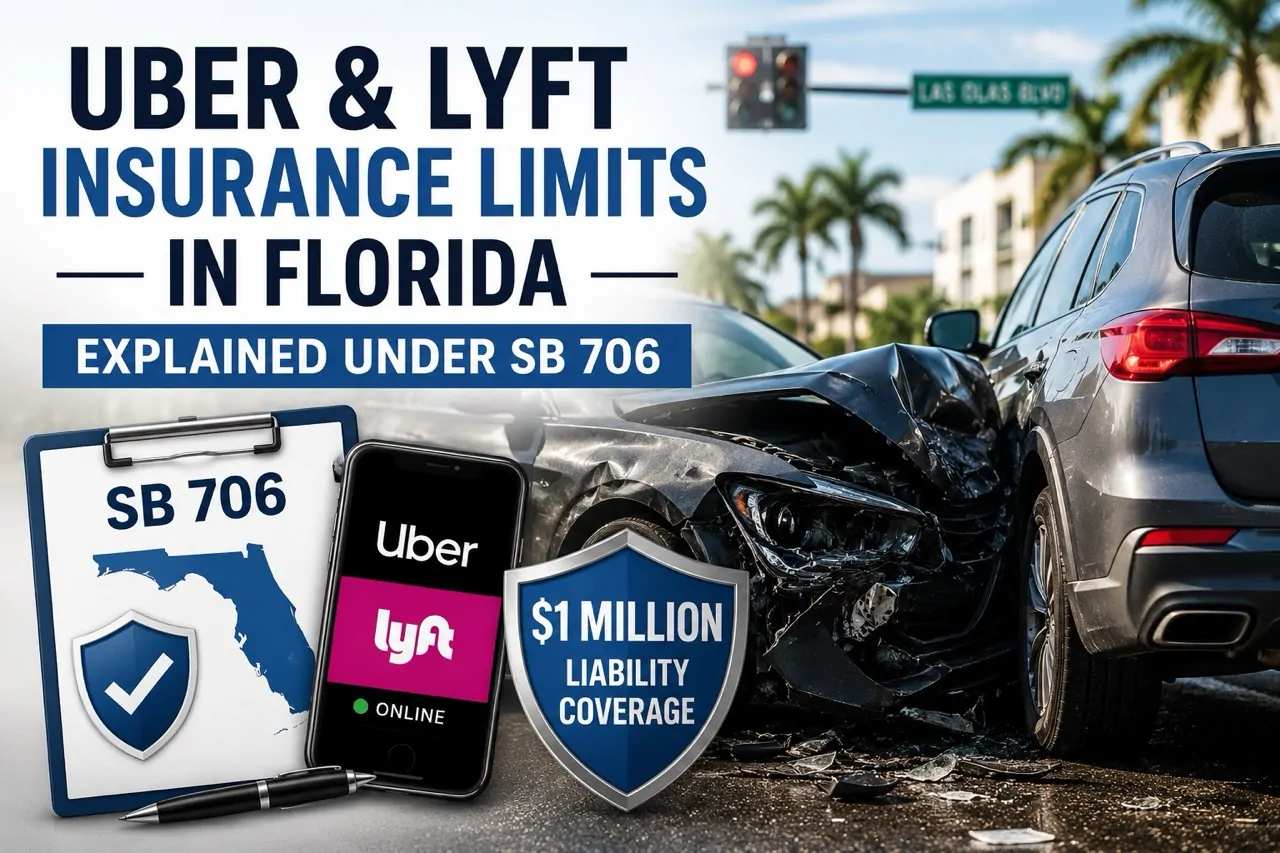
Uber/Lyft Insurance Limits in Florida Explained Under SB 706
A passenger requests an Uber near Las Olas Boulevard in Fort Lauderdale. The driver accepts the ride and begins navigation. Moments later, another vehicle runs a red light. The crash leaves the passenger seriously injured. Now the question becomes critical.
Which insurance policy applies? This is where Uber/ Lyft insurance limits Florida under SB 706 directly shape what compensation is available to you.
Rideshare accidents involve multiple insurance layers that shift depending on the driver’s status at the exact moment of the crash. Most victims do not realize coverage can change within seconds based on app activity. If you are dealing with a similar situation, speaking with a lawyer who handles rideshare injury cases in Pompano Beach can help clarify which insurance coverage applies.
C.H. Smith Law Firm has helped injured clients navigate exactly these situations across South Florida. Our team also works with clients across the region, including those seeking guidance from a Broward County attorney experienced in Uber and Lyft accident claims. If you have been injured in a rideshare accident, C.H. Smith Law Firm is here to help you understand your options and pursue the compensation you deserve.
What Florida SB 706 Actually Changed for Uber and Lyft Insurance
Florida SB 706 established the legal framework that governs how rideshare companies like Uber and Lyft must provide insurance coverage in this state. Before this law existed, coverage obligations were inconsistent and frequently disputed. SB 706 created clear requirements tied to driver activity, giving injured victims a defined legal basis for pursuing compensation. Understanding what this law requires, and how it applies to real crashes in Broward County, is essential for anyone involved in a rideshare accident.
For many injured victims, interpreting how these rules apply in real cases requires guidance from a Florida attorney experienced in Uber accident claims and coverage disputes. The law sets the framework, but applying it correctly often depends on how insurers interpret driver activity at the time of the crash.
Why SB 706 Was Introduced
Florida enacted SB 706 to regulate Transportation Network Companies operating in the state. Before its passage, rideshare insurance obligations existed in a legal gray area. Victims often faced situations where neither the driver’s personal policy nor the TNC’s commercial coverage clearly applied.
SB 706 ended that ambiguity by defining exactly when rideshare companies must provide coverage and at what minimum levels. It created accountability where none previously existed. In practice, many of these disputes still arise, which is why victims often rely on legal professionals who handle Lyft-related injury claims across Florida to clarify how liability is assigned.
Minimum Insurance Coverage Requirements
Coverage under SB 706 depends on what the driver is doing at the time of the crash. If the app is off, only the driver’s personal insurance applies and the rideshare company has no responsibility. If the app is on and the driver is waiting for a ride request, the law requires at least $50,000 per person and $100,000 per accident for bodily injury, along with $25,000 for property damage. Once a ride is accepted or in progress, Uber Lyft insurance limits Florida require a minimum of $1 million in liability coverage.
How SB 706 Applies in Broward County Crashes
Broward County sees a high volume of rideshare activity across Fort Lauderdale, Hollywood, Pompano Beach, and surrounding areas. When crashes occur on local roads like I-95, Sunrise Boulevard, or Las Olas Boulevard, SB 706 determines which coverage tier applies.
Local enforcement and civil courts reference this law when resolving coverage disputes. Knowing how Uber/Lyft insurance limits Florida operate under SB 706 allows your attorney to immediately identify which policy applies and challenge any attempt to deny coverage.
How Rideshare Insurance Coverage Actually Shifts During a Trip
Most people assume Uber or Lyft always cover their drivers. The reality is more complicated. Coverage activates and deactivates in real time based on what the driver was doing at the exact moment your crash occurred. This distinction determines everything about your claim. Many victims only understand this after speaking with a Fort Lauderdale attorney who handles Uber accident cases involving complex insurance disputes, especially when coverage is denied or reduced.
Here is how each phase of driver activity affects the coverage available to you:
App Off: Personal Insurance Only
When a driver has not logged into the Uber or Lyft platform, they are operating as a private individual. The rideshare company carries zero obligation during this period. Only the driver’s personal auto insurance applies.
Many personal policies contain explicit exclusions for commercial or rideshare activity. If the driver’s personal coverage is insufficient or excludes rideshare use entirely, injured victims face a serious gap with no TNC policy to fall back on.
App On, Waiting for a Ride Request
Once a driver activates the app and waits for a passenger assignment, limited TNC liability coverage comes into effect. Under Florida SB 706, this contingent coverage only activates if the driver’s personal insurance does not apply or is insufficient. The coverage limits during this phase are significantly lower than what applies during an active trip.
Victims injured at this stage often find that available compensation falls short of covering serious injuries and long-term care needs. These situations frequently require guidance from a Lyft accident lawyer familiar with Fort Lauderdale rideshare insurance rules, especially when insurers attempt to minimize coverage.
Ride Accepted or Passenger in the Vehicle
This is when the full commercial policy activates. Once a driver accepts a trip request or a passenger is physically in the vehicle, Uber/Lyft insurance limits Florida require up to one million dollars in liability coverage. This is the most protective tier for injured victims and covers bodily injury to third parties, property damage, and in some circumstances uninsured and underinsured motorist claims.
Rideshare coverage depends entirely on driver activity:
- Personal policy applies when the app is off
- Limited coverage applies when the driver is waiting for rides
- Full one million dollar policy applies during active trips
- Coverage disputes frequently arise when app status is contested after a crash
What Uber and Lyft Insurance Limits Mean for Injured Victims in Florida
Understanding Uber/ Lyft insurance limits Florida is not just a legal exercise. It directly determines whether your medical bills, lost income, and long-term care costs are covered after a serious crash.
When the full one million dollar commercial policy applies, injured victims have access to meaningful compensation for emergency treatment, hospitalization, surgical procedures, and rehabilitation. Long-term care costs become recoverable when injuries result in permanent impairment or ongoing medical needs. Lost income during recovery and reduced earning capacity going forward are both compensable under a properly documented claim.
However, when app status is disputed or coverage falls into a lower tier, the financial reality changes dramatically. A fifty thousand dollar policy limit can be exhausted quickly by a single hospitalization. Victims left with injuries that require months of treatment or permanent disability face losses that far exceed what lower-tier coverage provides.
Insurance companies representing Uber and Lyft are experienced at contesting app status and minimizing the coverage tier that applies. They do this because the difference between tiers is hundreds of thousands of dollars. An attorney who understands rideshare accident compensation in Florida knows exactly how to challenge those arguments and fight for the full coverage you are entitled to.
Where Rideshare Accidents Happen Most in Broward County
Broward County’s rideshare accident risk is concentrated in areas where passenger demand is high and traffic conditions change quickly. Fort Lauderdale’s nightlife districts create constant late-night rideshare activity, where drivers must manage both heavy vehicle flow and dense pedestrian movement.
Las Olas Boulevard remains one of the busiest pickup and drop-off corridors in the region, with frequent stops, congestion, and unpredictable traffic patterns. These conditions often lead to sudden braking and rear-end collisions. Many of these cases are handled by attorneys experienced in Fort Lauderdale rideshare accident claims and urban traffic collision patterns.
Hollywood Beach also sees a steady volume of rideshare traffic, especially during weekends, holidays, and large public events. Tourist-heavy areas increase the likelihood of navigation errors, unsafe stops, and distracted driving. Legal professionals familiar with rideshare accident cases in Hollywood’s coastal and entertainment zones often see recurring patterns tied to these conditions.
Sunrise Boulevard and the I-95 corridor experience consistent rideshare congestion throughout the day. Drivers frequently switch lanes, accept ride requests, and navigate tight spaces in fast-moving traffic. Late-night driving, frequent passenger pickups, and high tourism activity all increase the likelihood of crashes in these corridors.
These are the areas where Uber and Lyft insurance disputes most commonly arise, especially when determining which coverage tier applies under Florida law.
Evidence That Strengthens Uber and Lyft Accident Claims
Building a strong rideshare accident claim requires more than a police report and medical records. The most valuable evidence in these cases is digital, and it disappears or becomes inaccessible without fast legal action. Attorneys who regularly handle rideshare collision cases in areas like Coconut Creek and across Broward County understand how critical early evidence collection is to proving liability and securing full insurance coverage.
An experienced attorney moves immediately to secure the following before it is lost:
App Activity Records
Uber and Lyft maintain detailed records of driver app status, including when the app was activated, when a ride was accepted, and when the trip ended. This data directly determines which coverage tier applies under Florida rideshare insurance laws. When insurers dispute app status to avoid higher coverage obligations, app activity records provide objective proof. Black lawyers experienced in handling Uber-related accident claims in Coconut Creek often rely on this data to establish coverage eligibility and liability.
Trip Data and GPS Logs
GPS records confirm the driver’s location, route, and movement timeline before and during the crash. This data supports witness accounts, establishes speed and direction, and can challenge inaccurate driver statements. Trip logs also confirm whether a passenger was in the vehicle at the time of impact, which is critical for activating full commercial coverage. Attorneys handling Lyft accident cases in Coconut Creek and surrounding areas frequently use this type of digital evidence to strengthen claims.
Driver Background and Safety History
Uber and Lyft are required to conduct background checks on drivers. When a driver has a history of traffic violations, prior accidents, or safety complaints, that record becomes relevant to establishing negligence. A pattern of unsafe behavior may also support arguments for additional damages beyond standard compensation.
Crash Reports and Witness Statements
Official police reports document the initial factual record of the crash, including driver information, road conditions, and preliminary fault assessments. Witness statements add human context that digital data alone cannot provide. Together, these sources build a foundation that supports every element of your liability argument.
Strong rideshare claims rely on a complete evidence package:
- Uber and Lyft app data confirming driver status
- Insurance communication records from all involved carriers
- Vehicle damage reports documenting impact severity
- Medical documentation establishing injury causation and extent
- Traffic camera footage capturing the crash itself
How a Broward County Rideshare Accident Lawyer Builds Your Case
Rideshare accident claims require a legal strategy that accounts for corporate insurance systems, app-based evidence, and multiple competing policies. A general personal injury approach is not sufficient for these cases. Attorneys with experience in handling serious injury claims across Broward County and Fort Lauderdale build rideshare cases differently from the ground up, focusing on layered liability and insurance exposure.
Here is how C.H. Smith Law Firm approaches rideshare accident cases in Broward County:
Identifying Active Insurance Coverage
The first step is determining exactly which coverage tier applied at the moment of your crash. Your Broward County Black rideshare accident lawyer reviews app data, dispatch records, and trip logs to establish driver status beyond dispute. This process is similar to how a Fort Lauderdale personal injury attorney evaluates complex accident claims involving multiple insurance policies. This determination shapes every subsequent decision about which policies to pursue and in what order.
Challenging Insurance Denials
Insurance companies representing Uber and Lyft routinely dispute coverage based on app status, driver classification, or policy exclusions. An experienced attorney anticipates these tactics and prepares counter-arguments backed by documented evidence. When insurers attempt to shift your claim into a lower coverage tier, your attorney responds with a strategy used by lawyers handling injury cases throughout Broward County involving aggressive insurance defense tactics.
Calculating Full Damages
Compensation in a serious rideshare accident extends well beyond immediate medical bills. Your attorney calculates the full financial impact of your injuries, including future treatment costs, lost earning capacity, permanent impairment, and non-economic damages like pain and suffering. Presenting a complete and documented damages calculation prevents insurers from undervaluing what your case is actually worth.
Attorney Courtney Smith’s Experience With Rideshare Cases
Attorney Courtney Smith is a Florida Bar licensed personal injury attorney with nearly 20 years of litigation experience. He has handled Uber and Lyft accident claims involving complex insurance disputes, app status challenges, and multi-party liability across South Florida. His courtroom familiarity in Broward County Circuit Court gives him a direct understanding of how local judges evaluate rideshare cases and what arguments carry weight in that jurisdiction.
He has navigated the specific insurance structures that govern Uber/Lyft insurance limits Florida and knows how to build claims that hold rideshare companies and their insurers accountable. His clients receive experienced, direct representation at every stage of the process.
Frequently Asked Questions About Uber & Lyft Insurance in Florida
1. What insurance covers Uber accidents in Florida?
Uber provides coverage depending on driver status, including up to one million dollars in liability coverage during active trips under Florida SB 706.
2. When does Lyft insurance apply after a crash?
Lyft coverage applies when the driver is logged into the app or actively transporting a passenger, with coverage levels increasing based on trip status.
3. Can I sue Uber or Lyft after an accident?
You may pursue claims against Uber or Lyft depending on driver status, fault, and the severity of your injuries at the time of the crash.
4. What is the insurance limit for rideshare drivers in Florida?
Under SB 706, Uber/Lyft insurance limits Florida can reach one million dollars in combined liability coverage during active rides.
5. Does personal insurance cover Uber accidents?
Personal policies typically apply only when the rideshare app is completely off and the driver is not engaged in any platform activity.
6. Who pays medical bills after a rideshare crash?
Florida PIP coverage applies to initial medical costs, with additional claims available through Uber or Lyft’s commercial policy depending on driver status.
7. How do I prove the driver was on an active trip?
App activity records and trip logs maintained by Uber and Lyft confirm driver status at the exact time of the crash.
8. Can insurance companies deny rideshare claims?
Yes. Insurers frequently dispute driver app status or liability to reduce coverage obligations, which is why legal representation is critical.
9. How long do rideshare accident cases take?
Case timelines vary based on injury severity, insurance disputes, and whether the case is resolved through settlement or proceeds to trial.
10. Should I contact a black lawyer after an Uber crash?
Yes. Legal guidance from an attorney experienced in Uber/Lyft insurance limits Florida protects your rights and maximizes your claim value from the start.
Speak With C.H. Smith Law Firm About Rideshare Accident Claims
Rideshare accidents involve layered insurance systems and complex legal questions that change based on a single moment in time. C.H. Smith Law Firm helps injured clients identify which coverage applies, preserve critical digital evidence, and pursue claims with the full force of experienced legal representation.
Plantation Office
7805 S.W. 6th Court, Plantation, FL 33324
Phone: +1 (954) 228-9334
Tampa Office
201 E. Kennedy Blvd, Suite 600, Tampa, FL 33602
Phone: +1 (813) 322-5335
Email: info@chsmithlaw.com
